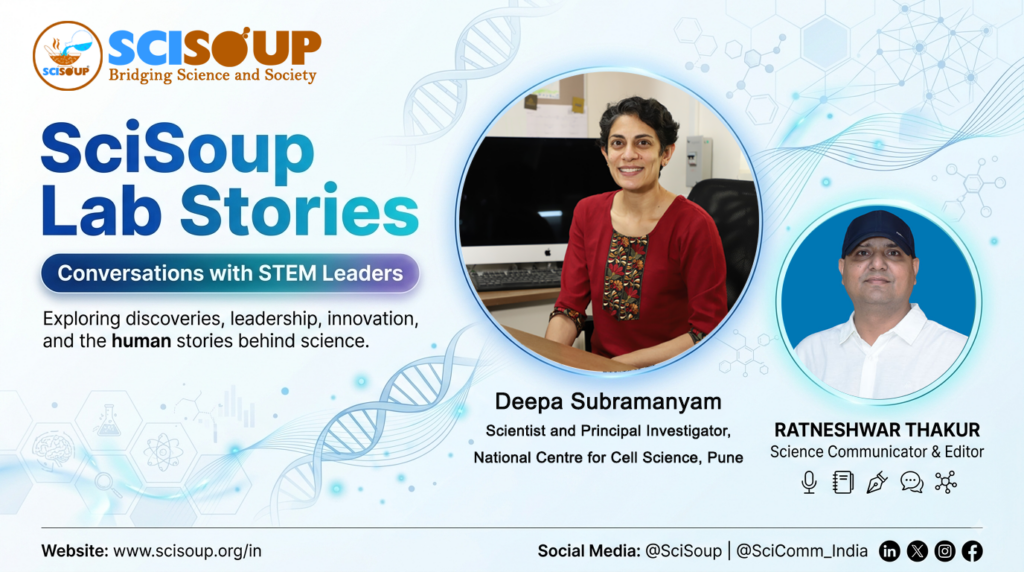
SciSoup Lab Stories – A Conversation with Dr. Deepa Subramanyam
Stem Cell biologist Dr. Deepa Subramanyam of BRIC–National Centre for Cell Science (NCCS), Pune, reflects on cell biology, stem cell fate, leadership, mentorship, and the future of understanding early development.
Scientific discovery often begins with curiosity, sometimes sparked by an unexpected encounter. For Dr. Deepa Subramanyam, Scientist at BRIC–National Centre for Cell Science (NCCS), Pune, her fascination with science began during high school when she discovered her mother’s old genetics notes. This early interest evolved into a research journey spanning cancer biology, stem cells, cellular reprogramming, and intracellular trafficking.
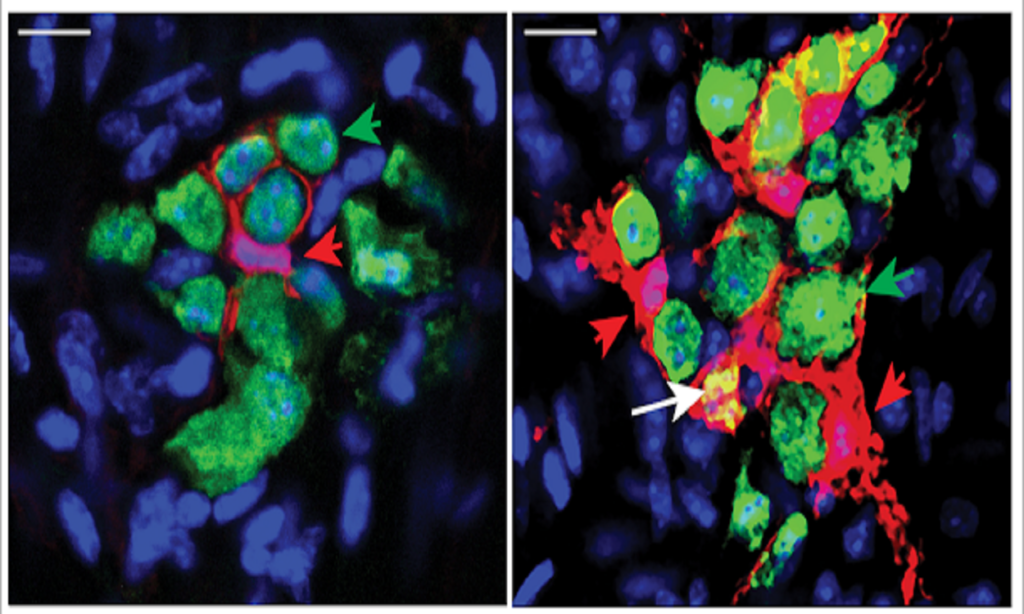
Her research explores how the movement and localization of molecules within embryonic stem cells influence cellular signalling, gene expression, and cell fate decisions.
In this edition of SciSoup Lab Stories, Dr. Subramanyam reflects on her scientific journey, interdisciplinary collaborations, research challenges, and the rewarding experience of mentoring young scientists. She highlights the potential of artificial intelligence in analysing biological data while emphasising the irreplaceable role of human researchers. She also underscores the importance of science communication, diversity, and inclusion in research.
Looking ahead, she envisions advanced imaging technologies that could reveal the dynamic molecular and cellular processes governing early mammalian development. Her reflections celebrate curiosity, resilience, fearless thinking, and the enduring spirit of scientific discovery.
The Beginning
While rooting around in an old cupboard as a high school student, I found my mother’s notes on Genetics (from either her BSc or MSc). I was immediately hooked – of course it also helped that her diagrams were beautiful, and her note-taking, meticulous. From there, it was a journey that led to research through the fields of cancer biology, stem cells and reprogramming and now looking at trafficking in stem cells.
Shaping a Scientific Career
I am still learning. The form of learning and the content only changes at different stages of life. In terms of managing a group, I had to learn to work with people from diverse backgrounds and different personalities. And when you add the vagaries of research to that, you are constantly walking a tightrope – managing finances, resources, emotions, failures and challenges. We also have to constantly tweak the scientific question by adopting new techniques, incorporating new hypotheses and discoveries and dealing with reagents that just don’t work at times.
Research Focus – Questions That Matter
I am fascinated by how the localization and presence of specific proteins at specialized locations can regulate what a cell becomes during development. We work with embryonic stem cells, which are cells isolated from the early embryo. These cells can form any cell present in the body. We are currently interested (and excited) to understand how the movement of molecules within these cells can (or may) influence what the cell chooses to become.
- How Cells Decide What to Become
As I mentioned earlier, we are interested in studying the movement of molecules within embryonic stem cells, as this movement may result in either the removal or accumulation of specific molecules in certain locations. Many of these molecules are involved in triggering a signalling cascade, which in turn leads to the activation or inactivation of specific genes. Such altered gene activity can influence the cell type that the stem cell converts into, thus regulating cell fate.
Interdisciplinary Approach
I have had, and continue to have many fantastic collaborators, who have helped add depth to many of the scientific questions that we are currently addressing. We have collaborations with physicists, computational physicists, neurobiologists and systems biologists. Our collaborators bring a different perspective to our work and novel avenues to address many of our questions. Through our collaborations, we have also started working with the fruitfly, Drosophila melanogaster to study mechanisms that are conserved across species.
Breakthrough – Lessons from Curiosity
The results from our first screen where we identified clathrin heavy chain as a critical regulator of stemness in embryonic stem cells was particularly memorable. This was until then an unknown interaction and all the research that we did after this was focused on understanding the role of clathrin in stem cells. Therefore, I think this was a transformative moment.
Research Philosophy – Challenges and advice
I have faced some challenges during my academic career. These include challenges with receiving funds with significant delays from the funding agency, along with some issues with gender discrimination. I would advise students to develop a good support system, find a mentor (can be a single person, or multiple people), not be afraid to call out misdemeanours, and develop a tough skin to get through it all.
Mentorship – Nurturing Independent Thinkers
The most enjoyable part about working with students is helping them transition into mature scientists. Young researchers need to be fearless. The fear of failure often holds people back from thinking big and bold.
AI and the Future of Science
Biology is now going through a phase where huge amounts of data are being generated. Further, there are already large data sets generated from multiple sample/patient sets. AI would be extremely useful in helping assimilate these data sets and sifting through them for relevant information. For example, this could entail applying various criteria to identify relevant hits, which could then be tested through experimental assays. While AI can assist in simplifying data access and maybe, interpretation, I do not think it can completely replace human researchers.
Science Communication – Connecting with Society
Since most of our research is conducted using taxpayers’ money, it is very important to regularly communicate the work being carried out in our laboratories. Without such communication, the general public perceives the majority of research groups as mere hobby-chasers, as all research does not result in the generation of a product or pill. It is of paramount importance to explain how translational research rests on the broad shoulders of basic research and that the former cannot exist without the latter. Establishing a regular dialogue is also required for busting certain myths and providing clarity to scientific discoveries and procedures.
Diversity and Inclusion
Efforts have been made to promote diversity and inclusion at the scientist and senior administrative positions. However, things are still far from perfect. The proverbial leaky pipeline is indeed very leaky (and not just with respect to gender) and efforts have to be made at all levels to ensure that there are opportunities to promote diversity and inclusion. We need a sensible change in policy, to ensure this.
Future Directions
While we know many aspects of how the body plan is established in early development, it is still challenging to study these in post-implantation mammalian embryos. It would be fantastic to develop methods for continuous in-utero imaging that can track molecular markers to help us understand cellular movements, changes in gene expression and molecular trafficking.