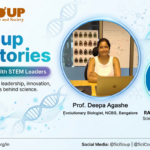
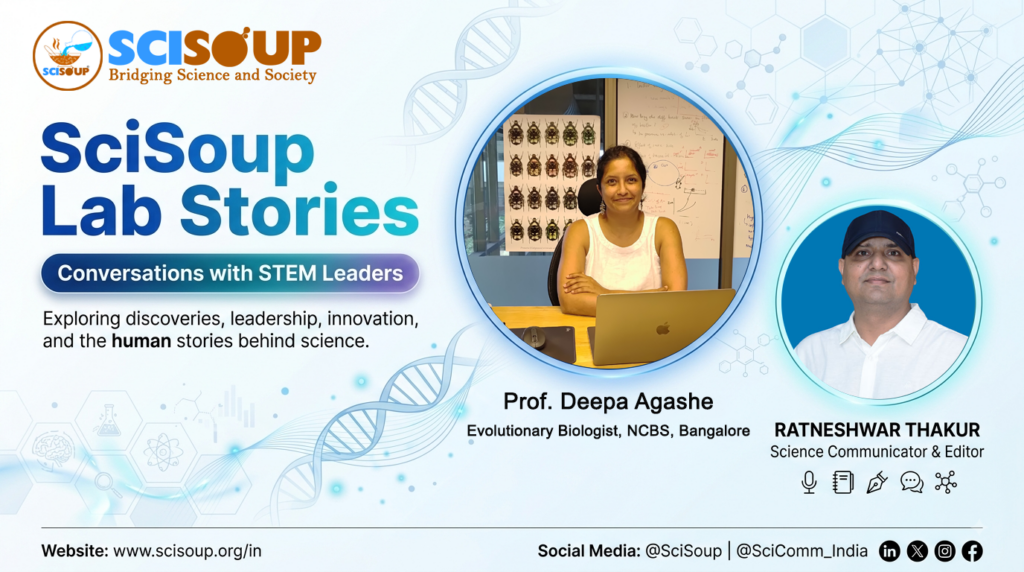
SciSoup Lab Stories – A Conversation with Prof. Deepa Agashe
- SciSoup
- October 14, 2026
RATNESHWAR THAKUR
A Conversation with Prof. Deepa Agashe, Evolutionary Biologist, National Centre for Biological Sciences (NCBS), Bangalore - On Evolutionary biology, Leadership, Mentorship, and the future of understanding evolution.
From the Editor
Scientific discovery often begins with curiosity—a question that refuses to go away, an unexpected result, or a desire to understand how the natural world works. The scientific journey of Deepa Agashe, a researcher at the National Centre for Biological Sciences (NCBS), Bengaluru, reflects this spirit of curiosity, persistence, and exploration.
Working in evolutionary biology and ecology, Agashe uses experimental evolution to observe evolutionary change in real time. By repeatedly sampling evolving populations, researchers can create a detailed record of adaptation and examine the mutations, genes, and processes that shape evolutionary outcomes.
Her journey into science was encouraged by enthusiastic teachers, a family that valued curiosity, undergraduate research experiences, and the excitement of learning alongside peers. From early interests in genetics and evolutionary biology to doctoral and postdoctoral training, different stages of her career helped shape how she thinks about experiments, scientific writing, collaboration, and scholarship.
In this edition of SciSoup Lab Stories, Agashe reflects on the experiences that shaped her scientific career, the value of experimental evolution, and the role of collaborations across mathematics, molecular biology, and other fields. She also discusses a particularly unexpected discovery about mutation spectra and adaptation that emerged during the pandemic.
The conversation explores the realities of research, the importance of learning from failure, the joy of mentoring students into independent scientific thinkers, and the need to provide sustained opportunities and support so that people from diverse backgrounds can contribute fully to science.
Looking ahead, Agashe highlights the growing importance of integrating evolutionary biology with chemistry, molecular and cell biology, mathematics, and microbial ecology. Her reflections offer a glimpse into how combining different perspectives can help scientists move from explaining evolutionary patterns to asking whether some aspects of evolution can be predicted.
The Beginning
I became interested in science sometime in middle to high school. In Class 11, I was lucky to have a super-enthusiastic maths teacher and a fantastic chemistry teacher who quietly nurtured my excitement about chemical reactions and the chemistry lab. My mother was always interested in research. She encouraged me to think and be curious, and my parents were very happy to let me choose my own career. All of these things made it very easy to decide to become a scientist.
By the time I finished school, I knew that I wanted to do research in genetics. My mother heard about Garware College in Pune, where the microbiology department, led by Prof. Watve, encouraged undergraduate research. I was reintroduced to evolutionary biology and ecology there, and that immediately captured my interest! I did several research internships during my BSc, some supported by the Academies’ Summer Research Fellowships at GKVK and IISc. Those experiences further solidified my love for these fields.
Shaping a Scientific Career
In my undergraduate course, I found friends who were as excited as I was about science and discovery, which was crucial for my development. Though formal learning in classes was limited, we learnt a lot by discussing science, reading, and exploring on our own outside college. This shared excitement was key to finding out what I enjoyed most and what I was reasonably good at.
Another important period for my growth was graduate school, where I met many peers who were much smarter than me and who knew so much! But the good news was that I could learn and get better, and there was plenty of inspiration all around. Another really influential experience during this period was attending regular departmental seminars that covered a wide range of topics in ecology, evolution, and behaviour. I absorbed a lot from these talks, learning not only about diverse topics and interesting research but also how to give a good talk.
My department regularly offered small competitive research grants and fellowships, and repeatedly writing grant proposals to support my thesis work helped me clarify my thinking and learn this important craft. My PhD advisor, Prof. Bolnick, taught me how to write in science. As a postdoctoral fellow with Prof. Marx, I learnt many key methods in molecular biology and genetics, so that I could loop back to my love of genetics.
Looking back, these PhD and postdoc years were packed with rich experiences that taught me how to think and plan experiments, how to write, and what it means to be a scholar. Along the way, I also learnt a lot about academia, teamwork, friendship, my strengths, and where I needed to put in more effort.
Research Focus – Questions That Matter
My area of research is evolutionary biology and ecology. A lot of our work involves experimental evolution, a very useful method that allows us to observe evolution in action. We can move from looking at evolution largely retrospectively to analysing it in real time, making this a very powerful way to understand which factors increase or decrease the rate of evolution and influence its outcomes.
We can maintain a fossil record in the freezer by saving samples periodically, allowing us to build a very detailed, multi-layered record of the minutiae of the process. For example, we can understand how many mutations are involved in adaptation, which mutations and genes are involved, and whether the patterns we observe in short-term evolution experiments match those seen over millions of years across species.
This is important for predicting evolution in the future, not only to better understand the basic processes that are hallmarks of life but also for applications such as combating drug resistance in bacteria and cancerous tissues, and mitigating the effects of climate change on natural populations.
Interdisciplinary Approach
We have worked with mathematicians as well as molecular biologists who bring different techniques and perspectives to address the problem at hand. In several cases, these collaborations were critical to understanding important details of the underlying processes and measuring the outcomes of evolution. I think this is typical of the best collaborations in science, where team members bring different ideas and approaches and, together, can piece together a much bigger part of the puzzle than we can on our own.
Breakthrough – Lessons from Curiosity
During the pandemic, we stumbled into a really exciting discovery. You may recall that DNA has four bases: A and G are purines, while C and T are pyrimidines. While quantifying the consequences of single mutations in bacteria, my PhD student, Mrudula Sane, had found that transversion mutations — where a purine changes to a pyrimidine base (or vice versa) — were somehow much more beneficial to bacteria than transition mutations (where a pyrimidine base changes to a different pyrimidine base, or a purine to another purine). This was puzzling because transversion mutations are generally thought to be more likely to be deleterious than transitions. But our results were exactly the opposite, and for quite some time, we tried to think about and analyse our data in different ways to understand why.
Just before the pandemic hit, I had discussed this problem with a mathematician colleague, Prof. Wahl, who was in Bengaluru teaching at a workshop that I had helped organise. As the world shut down, we continued talking about this problem. Prof. Wahl had intuited quite early what might be going on, and once she was back home in Canada, she ran some simulations that confirmed her hunch. She showed that transversions were beneficial because our bacteria had sampled largely transition mutations in their evolutionary history. As a result, in our dataset, transversion mutations were more likely to include beneficial mutations, and we had captured this effect because some of our bacteria had very high numbers of transversion mutations.
Mrudula did more analyses to confirm that our results could not be explained by other factors. But at the time, we only had data on two bacterial strains, and we wondered whether the types of mutations sampled by bacteria (called the mutation spectrum) changed frequently in bacteria. A former PhD student from my lab, Dr. Gaurav Diwan, had conducted phylogenetic analyses for his thesis and had done some preliminary work to figure out when DNA repair genes — whose loss can change the mutation spectrum — were gained or lost over millions of years of evolution. Gaurav joined this project as well and found that successive losses (or gains) of repair genes in bacterial lineages may often lead to switches in the transition–transversion bias.
This suggested that changes in mutation bias may not be rare, and the theory and simulations showed that this should be a very general phenomenon: accessing previously rare types of mutations should generally be beneficial in environments where advantageous mutations are limiting. This is really exciting because it opened a completely new window into understanding the role of mutations in adaptation, in addition to selection.
This understanding opened up many new lines of inquiry in the lab, and we have continued to work with Prof. Wahl to address these. Several sets of experiments have now validated the new predictions we made, and it has been very illuminating and exciting to think about the role of mutational processes in evolution. Only once in a while does such a completely new direction emerge in the lifetime of a laboratory, and I am thrilled that we had this experience.
Research Philosophy – Challenges and advice
I don’t think I have personally faced any impossibly difficult obstacles. Of course, the usual challenges came up: mastering new subjects, figuring out what questions are worth asking, and deciding the best way to answer them. Sometimes, interpersonal relationships in academia, where there is a lot of freedom but also large differences in experience and expertise, are difficult to navigate.
With all of these challenges, I think it helps to keep an open mind, find out what one needs to do, and then go about single-mindedly getting it done. Learning how to do science means thinking hard, but also just trying things out and learning from failures. Sometimes, mastering tricky concepts takes longer than expected, but it is usually well worth the effort, even if it ends up not being directly relevant to a specific problem.
Mentorship – Nurturing Independent Thinkers
It is such a joy to observe students develop and grow. One of the most rewarding stages of working with a student is when they blossom into a colleague who can hold their own in a deep scientific discussion and begin challenging you. I also enjoy learning about new concepts, work, and methods from PhD students as they develop their thesis projects and go beyond what I know, pushing me to learn more along with them.
I would encourage aspiring researchers to develop the habit of thinking deeply about whatever they are doing, and to broaden their horizons and follow up on the hundred threads that emerge as they think. This can sometimes involve repetition, going well beyond your comfort zone, finding and talking to experts, discussing ideas with peers, and struggling with difficult concepts and connections. It may get overwhelming, but it is incredibly enriching and satisfying to truly understand something well. It is good if this process becomes a habit while you are a student.
Diversity and Inclusion
In biology, I think things are getting better on all these fronts; it helps that people are more aware of these issues now. To make ongoing efforts more impactful, it will be important not to lose focus on serious scholarship, depth, and excellence, so that the progress we make now will generate feed-forward loops in the future.
For example, it is not enough just to provide research opportunities to all; we also need to provide what is necessary for everyone to have a chance to excel. Plenty of research shows that systemic differences can build up over time among students of similar ability, e.g., due to gaps in exposure or training. So, a student whose background has put them at a disadvantage may need to be given a taller chair — e.g., more exposure and remedial training — to help them see as far as others. Then, they will all have a chance to contribute new ideas to science.
Institutions and governments often find it easier to create the initial opportunity, but in research, it is critical to also ensure sustained resources and ancillary support to make the most of that opportunity.
Future Directions
In evolutionary biology, I think many exciting new discoveries will come from serious inputs from other fields, such as chemistry, molecular and cell biology, and mathematics. Evolutionary biology has traditionally been a field that explains what we see and what may have happened in the past, but incorporating inputs from these other fields is gradually enabling us to predict broad patterns of evolutionary outcomes. However, given the inherent stochasticity of evolutionary processes, forecasting what might happen in the future is extremely difficult, especially at finer levels of detail. I think collaborations across different fields will help address this problem.
Another major challenge is reconciling micro- and macroevolutionary patterns and processes. As I mentioned earlier, experimental evolution gives us incredible insights into microevolution, i.e., evolution over short timescales. Logically, these same processes, occurring repeatedly over millions of years, should explain macroevolutionary outcomes, such as the origin and extinction of species. But there are several inconsistencies across these timescales, and I think we will figure those out in the coming years, which will be very exciting.
Finally, I think we will understand much more about microbial evolution in nature through the cross-fertilisation of ideas and observations from microbial ecology and evolution, both in the field and in the laboratory, and through the development and use of new methods to track microbes in the chaos of natural environments. I am really looking forward to these advances.