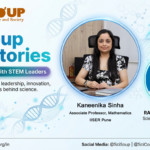
SciSoup Lab Stories: A Conversation with Prof. Kaneenika Sinha
- SciSoup
- October 19, 2026
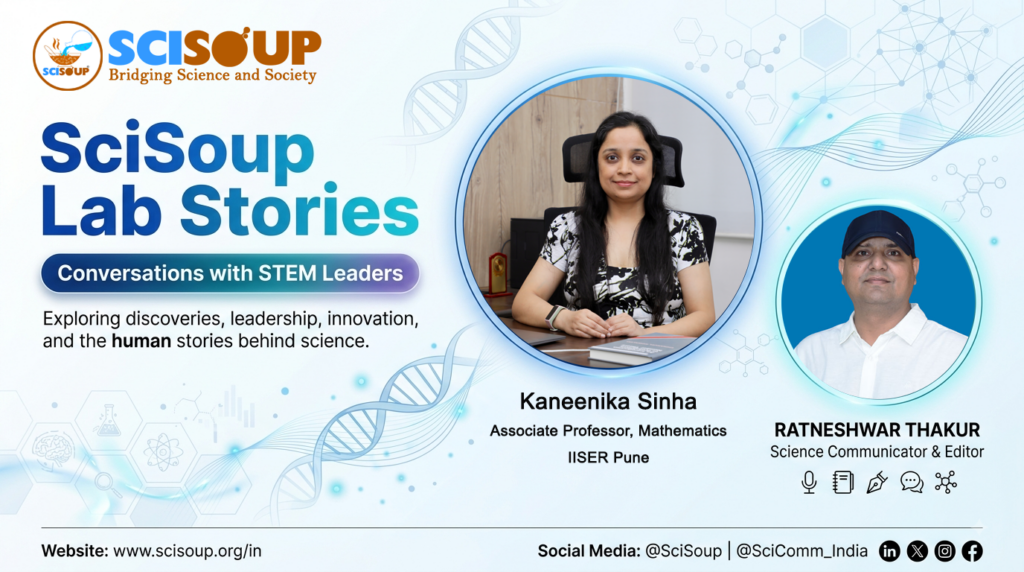
RATNESHWAR THAKUR
Mathematician Prof. Kaneenika Sinha of the Indian Institute of Science Education and Research (IISER) Pune reflects on her journey, the beauty of mathematical thinking, probabilistic number theory, collaboration, mentorship, and the emerging role of artificial intelligence in mathematical discovery.
From the Editor
Mathematics is not just about numbers and equations. It is also about curiosity, recognising patterns, and finding new ways to approach questions. Prof. Kaneenika Sinha, a mathematician at the Indian Institute of Science Education and Research (IISER) Pune, has built her research career around this spirit of exploration.
Sinha works at the intersection of probability and number theory, studying patterns in numbers and exploring how they relate to randomness. Her work connects with questions that have intrigued mathematicians for generations.
Her journey began with a childhood spent moving between schools because of her father’s army posting. Often, she had to study on her own to keep up with her classes. Mathematics, which she initially tackled because it was the most difficult subject, gradually became a source of fascination through its problems and patterns. Over the years, research has taught her that progress rarely comes all at once. It often takes patience, learning from mistakes, and the willingness to stay with a problem even when the answer seems far away.
In this edition of SciSoup Lab Stories, Sinha talks about the experiences that have shaped her as a mathematician, the excitement of finding unexpected connections, and the role of collaboration in research. She also reflects on mentoring young researchers, balancing academic and administrative responsibilities, and how artificial intelligence might help mathematicians explore difficult problems.
For Sinha, mathematics also extends beyond research papers and academic discussions. She emphasises the importance of communicating science to wider audiences and helping young people discover the possibilities it offers. Looking ahead, she shares the questions that continue to interest her and her excitement about the connections that different areas of mathematics can reveal.
The Beginning
During my childhood, our family moved a lot because of my father’s job in the army. As a result, I would often have to miss school for many days or change schools frequently, which could also mean changing education boards. So, I had to cover the school topics on my own. To get the most difficult subject out of the way first, I would start with mathematics. Gradually, however, I got drawn into its world of problem-solving and patterns. It felt like getting engrossed in building LEGO structures or solving a jigsaw puzzle. But the realisation that I wanted to pursue mathematics as a career came much later, in the final year of college.
Shaping a Scientific Career
As an early-career mathematician, I started exploring problems in an area of arithmetic statistics that I knew very little about: pair correlation and level spacing statistics of arithmetic sequences. I sought advice from a senior mathematician in this field, who had not interacted with me before. He generously shared his knowledge, references, and feedback on the kinds of questions I wanted to explore.
I struggled for a long time before I could resolve some of these questions. It turned out that I had been stuck for almost six months because of a silly error that the mathematician pointed out within minutes when I shared my calculations with him.
While working on this problem, and on other projects that grew out of it, I would often find myself in a state of flow. I did not miss out on other essential activities, such as teaching, travelling, filing tax returns and handling other personal and professional administrative tasks, going to the gym, or visiting the doctor. But the project remained at the top of my mind throughout.
I look back on the process of completing this project and submitting the paper, not to mention the joy I felt when it was accepted, as a defining experience. It taught me a lot about persevering to finish what one has started and how perseverance can strengthen commitment. I learnt how to focus on a mathematical problem while managing anxieties and other responsibilities.
I also learnt that small steps can lead to progress and unexpected opportunities if you appreciate the value of what you are learning, keep going, and do not give up. For example, there was a time when I could not even understand the basic mathematics behind this area. A few years later, I had learnt enough to supervise a PhD thesis in the field and propose a research project with a collaborator. The project was funded by the Anusandhan National Research Foundation (ANRF). This grant has enabled us to hire two postdoctoral fellows who are now going through their own “rite of passage” into this exciting research area.
Of course, I have worked on many other projects, but whenever I reflect on defining moments in my career, I find myself reminiscing about this one.
The Power of Mathematical Thinking
Suppose you ask a question and cannot answer it. Mathematics teaches you to keep asking the question in different ways. It gives you a language to understand what you know about the question and what you do not. Often, it helps you solve a problem by connecting it to a framework with the right tools to address it. It also encourages you to see how your question fits into a larger set of deeper questions.
For example, prime numbers—whole numbers greater than 1 that are divisible only by 1 and themselves—are easy enough to explain to a high-school student. Yet, questions about them have fascinated mathematicians for centuries. One such question was explored by Carl Friedrich Gauss when he was just 15 years old. In 1792, he made a conjecture about how the number of primes grows as we consider increasingly large numbers. This became known as the prime number theorem, which was proved independently by Jacques Hadamard and Charles Jean de la Vallée Poussin in 1896.
An important step towards this proof came from Bernhard Riemann’s work in 1859. He showed how the study of a mathematical function, now known as the Riemann zeta function, could help answer questions about prime numbers. His ideas opened up new ways of approaching these problems and continue to influence number theory today. Broader efforts, such as the Langlands programme, seek to uncover deep connections between different areas of mathematics.
These ideas also have practical relevance. For example, the generation of large prime numbers and the difficulty of breaking down very large numbers into their prime factors underpin some of the cryptographic methods used to secure information exchanged online.
Research Focus – Questions That Matter
I work on problems at the intersection of probability and number theory. As I mentioned earlier, the distribution of prime numbers can be studied through a mathematical function called the Riemann zeta function. This helps us answer questions about patterns in prime numbers using ideas from mathematical analysis and probability.
More broadly, we can study patterns in sequences that arise from mathematical objects such as elliptic curves and modular forms. To understand these patterns, mathematicians study related functions, called L-functions, which carry important information about the underlying mathematical structures.
Lately, I have also been exploring what is known as the “explicit” side of number theory. This involves studying regions in which certain L-functions do not become zero, using mathematical tools closely connected to the algebraic structures underlying these functions.
Interdisciplinary Approach
Indeed, mathematical learning and progress come from a good balance between thinking independently and collaborating with others. In my early career, I benefited from collaborative projects in which an expert suggested and led the work, giving other collaborators, including me, the opportunity to explore a new area.
Another kind of collaboration arises when a problem requires ideas and tools from different areas of mathematics. For example, the way a problem is formulated may draw on an approach from one area, or on a method that a collaborator has used in a different context. However, applying that approach to a new problem may require familiarity with another area of mathematics.
Such collaborations push each of us beyond our comfort zones and help us approach research questions in new ways. They can also open up questions and directions that we might not have thought of exploring on our own.
Breakthrough – Lessons from Curiosity
A few years ago, my PhD student, Neha Prabhu, and I explored a problem related to the distribution of Fourier coefficients of certain families of modular forms. This project led us to investigate some statistical properties of these coefficients. We wanted to understand how frequently they fell within a given range as the families we studied grew larger.
In the beginning, we felt as though we were in a dark room, gradually making sense of the objects we encountered. As we continued, we began to see how much these questions could be understood through the lens of probability. We discovered that, for large families, the random variables we were studying behaved much like sums of independent Bernoulli random variables—a mathematical model for repeated random events with two possible outcomes.
This project led to several new questions involving other mathematical objects, which I continue to explore.
Research Philosophy – Challenges and advice
A fundamental challenge I faced was learning to balance my primary academic responsibilities, research and teaching, with administrative duties at the institute. At new institutions such as the IISERs, especially during their early years, faculty members had to work with limited resources and often take on responsibilities beyond the classroom to contribute to institution-building. It took me a while to learn how to balance all these responsibilities.
My advice to younger colleagues in similar situations is to serve the institution with enthusiasm and commitment in roles that match their skills. However, to ensure that these responsibilities have a meaningful impact, one should be thoughtful about taking on tasks that suit one’s skills and personality. We should also learn to manage these responsibilities in ways that do not leave us feeling drained.
Mentorship – Nurturing Independent Thinkers
In my experience, students usually approach their projects and study goals with tremendous energy and bring fresh perspectives. Holding regular discussions is a great way to make progress on a project.
I see the relationship between a mentor and mentee as one of synergy. We work towards a common goal, build ideas together, and bring complementary skills to a project. The outcome is as significant for the student as it is for the advisor, even though its impact on the student may be more evident. Every project I have completed with a student introduces them to a new research area and questions they may choose to explore before eventually developing their own research vision. At the same time, it adds a new dimension to my own research programme.
I like to suggest problems to students related to those that I have been thinking about myself, as these are important to and closely connected with my core research programme. On a deeply personal level, each successful project not only opens a path for the student but also renews my faith in larger goals. In this way, we become part of each other’s journey of growth.
I encourage young researchers to develop perseverance when working on problems and to think about them consistently, while also learning to live with the discomfort and uncertainty that challenging questions bring. An academic journey comes with many anxieties. It helps to recognise and accept them without letting them take over the process of academic growth or diminish our joy in achieving small milestones.
AI as a Collaborator in Mathematical Discovery
I see AI as a brilliant collaborator for mathematicians. In the last few months, we learnt that it can help in many ways: testing conjectures, searching for counterexamples, verifying long proofs, and quickly making a wide range of mathematical tools from different fields accessible to researchers. However, in early October, some developments took place which suggest a much larger collaboration and a serious disruption in the mathematical landscape.
OpenAI put out more than 700 preprints in 372 result families in various areas of mathematics, along with the Lean formalization of many of them. Many of these (such as the quasi Riemann hypothesis) are extremely difficult problems that have remained beyond the reach of mathematicians for several decades. These preprints are being evaluated by the larger mathematical community. In addition to mathematical correctness, we also need to understand the methods: do the methods involve bringing together many existing ideas from diverse mathematical fields at a scale that humans had not been able to accomplish before? Or are there genuinely new ideas and tools developed for the first time?
Soon after OpenAI’s announcements, we have heard of new developments, where mathematicians took these results and further improved them or generalized them. This suggests that AI and humans can be great collaborators in mathematical discovery, joining forces to attack open problems that seemed distant just a few weeks ago. We are trying to understand what AI is capable of achieving beyond human abilities: if it is capable of rearranging and connecting mathematical ideas in a much larger way than humans can do by themselves, we must leverage this for the growth of the subject. This is particularly valuable because mathematicians are becoming increasingly specialised in their individual areas of training. AI therefore has great potential to complement and enhance a mathematician’s intuition and range of knowledge. By and large, we need to tailor an effective Human-AI collaboration in a way that mathematics grows along with our understanding of it. In a country like ours where the educational infrastructure has not adequately met the needs of our population, AI can be leveraged as a valuable learning tool.
Bridging the Gap Between Science and Society
A few days ago, I found myself preparing two different presentations at the same time. One was for a research conference attended by specialists in my field, where I would present the latest results from an ongoing research project. The other was for high-school teachers who wanted to learn about what mathematicians do and how they could guide students interested in mathematics. Both were essential.
Communicating our discoveries to fellow researchers through seminars, articles, and discussions is just as important as communicating with the wider public who genuinely wish to understand our work. The public also plays an important role in creating the support, resources, and environment needed for scientific progress.
Scientists and STEM professionals must develop the skills to communicate with diverse audiences so that science can grow through collaboration among all stakeholders. These include scientists, government, industries that draw on scientific research to develop products, young students exploring careers in science, and parents and teachers, who often guide the next generation of scientists.
Future Directions
I am excited about many questions and directions in probabilistic number theory. An underlying theme in this area is the study of “deterministic” sequences arising from well-known arithmetic objects and the comparison of their distribution and spacing properties with those of random sequences. This also leads to the domain of random matrix theory, where interesting sequences and families of mathematical objects exhibit distribution patterns similar to those of eigenvalues in several types of random matrices.
To answer probabilistic questions, however, we cannot work in isolation. We need to study these arithmetic objects from multiple perspectives, including the analytic, algebraic, and geometric. The Langlands programme is a broad framework in mathematics that connects these perspectives, among others, and offers predictions and conjectures that provide deep insights into their relationships. I am excited to see the progress the mathematical community will make in these directions.