A Key Hormone In Mother’s Brain Protects Offspring From Predatory Threats
Fruit flies based new study sheds light on an exciting form of protection that mothers can confer on their babies before they are even born.
Caring for the offspring is one of the most fascinating and universal behaviors observed across the animal kingdom. The maternal instinct that dedicatedly protects and nourishes the offspring is witnessed in many animals, from mammals (humans) to insects (fruit flies). But we have little understanding of the biological/genetic basis of this robust and vital instinct, which is essential for the organism’s survival.
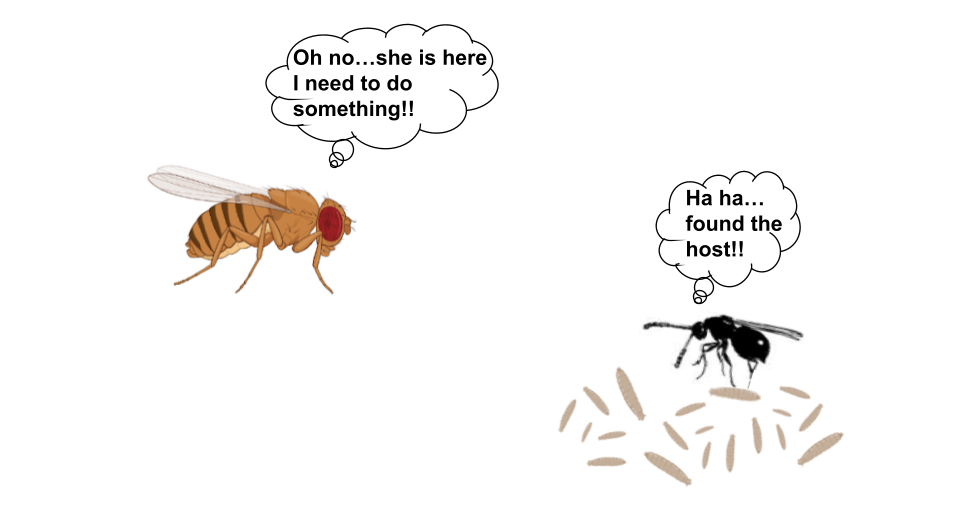
A recent study, published in PLoS Genetics by a research team in the Geisel School of Medicine at Dartmouth, sheds light on an exciting form of protection that mothers can confer on their babies before they are even born! The study used the interaction between fruit flies (Drosophila) and a parasitic wasp (Leptopilina boulardi) to understand the mechanisms that underlie maternal protection.
In nature, approximately 90% of fruit fly progeny are susceptible to infection by different parasitic wasps. Similar to fruit flies, wasps are also tiny insects and use fly larvae as their host to raise their progenies. To counteract the wasp infection, fruit flies have developed various defensive strategies. One such defensive approach is to delay laying eggs when the parasitic wasp is around. Strikingly, the adult fruit flies that are never infected by parasitic wasp decrease egg lay to reduce infection and increase the chances of survival of their progeny. The female fruit flies subsequently lay the retained eggs in wasp non-infested sites.
To understand the genetic and neuronal basis of this behaviour, Madhumala Sadanandappa, the lead author of the study and a post-doctoral fellow in Giovanni Bosco’s lab at Geisel School of Medicine at Dartmouth – USA, asked the following questions – how do parent flies recognize their threats? How is this parental instinct encoded in adult flies?
The authors found that mother fruit flies detect the wasp by smell and visual cues. These signals activate a signal in the fly brain that in turn causes retention of eggs. Authors found a peptide, Neuropeptide F(NPF), to be the messenger behind this motherly behavior. Furthermore, NPF was shown to regulate female reproductive organ development and function. The absence of NPF in female flies puts their offspring at risk as they continue egg laying even when wasp is around.
The research team included Madhumala K. Sadanandappa, Shivaprasad H. Sathyanarayana, Shu Kondo,Giovanni Bosco. The study was funded by the Human Frontier Science Program and the National Institute of Health.












“In summary, the above study explains the genetic basis of maternal protection and behavioral immunity in fruit flies. The outcomes of the current study have broader implications in fields such as neuroethology, evolutionary biology, and biocontrol.”