Researchers at NIPGR and ICGEB have found evidence for proteins with prion-like features as mediators of stress memory in plants, connecting for the first time, the lesser-known protein-based signals, with the better-known epigenetic signals in the emerging field of plant memory acclimation.
AUG 08, 2021 | BY RAJESH D. GUNAGE
Memory skills are essential to all living organisms in all aspects of life. Plant learning and memory has emerged as one of the most fascinating fields of study in recent years, especially in view of the intricate mechanisms evolved by plants to survive under ever-changing unfavourable and adverse environmental conditions. The current study has revealed how plants employ gene regulation tricks , epigenetic modifications and protein based signals to flourish and make decisions about remembering or choosing to forget an event.
Using a Computational Systems Biology approach in this article titled “Complex Networks of Prion-Like Proteins Reveal Cross Talk between Stress and Memory Pathways in Plants,” authors have consolidated a rapidly growing field of plant memory and learning. Insights into how plants may use memory to thrive could hugely benefit agriculture and address global challenges like food security in the face of climate change.
Humans have an ability to learn from previous experiences and this is vital for their survival. Aversion to fire is quickly learned by new borns. However, until the detection of epigenetic markings, memory was investigated only in humans or higher animal species as part of cognitive processes. In plants, memory responses have been investigated in ‘Touch-Me-Not’s and model species, from a physiological perspective. However, there are several unanswered questions about whether memorized experiences are genetically fixed and heritable or remain epigenetically variable in plants. The most widely investigated memory phenomenon in plants is related to the development of ‘stress memory’, which ‘primes’ the plant to remember a prior exposure to stress. Such ‘priming’ facilitates a faster and heightened response of resistance for subsequent stress episodes.
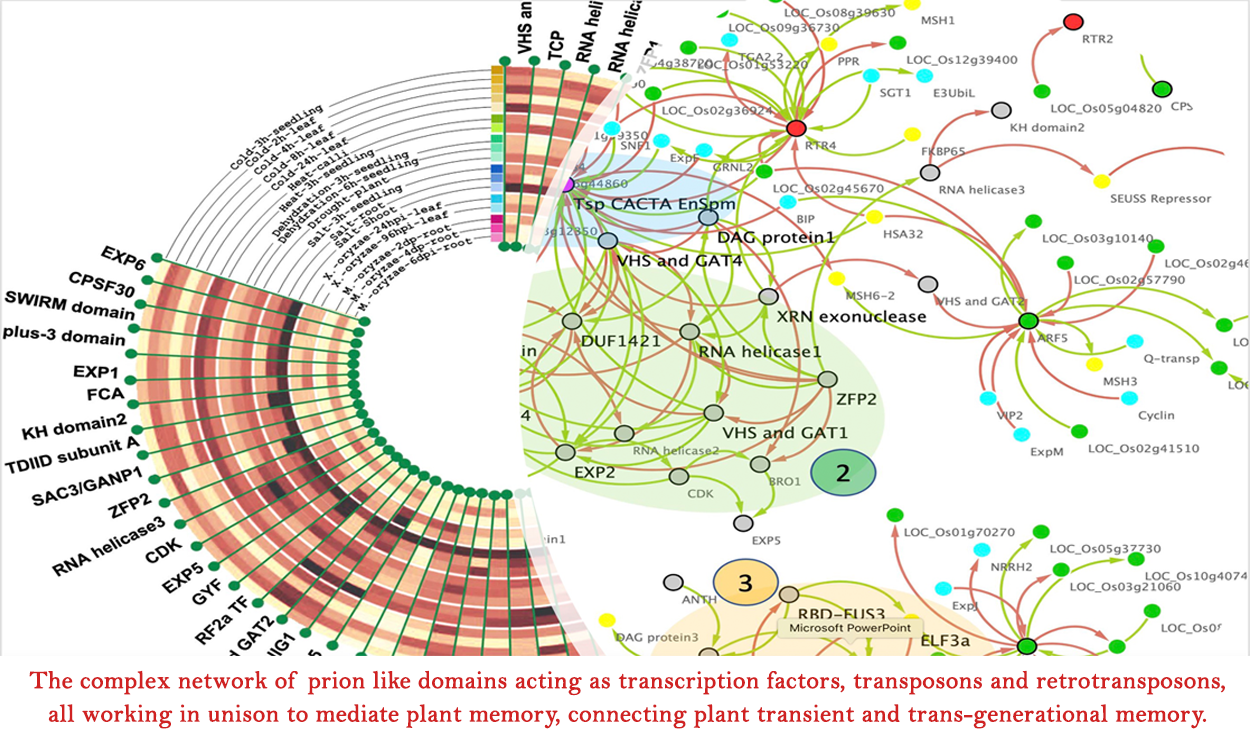
The team, led by Prof. Sudhir Sopory and Dr. Gitanjali Yadav, took a novel perspective, unlike the conventional ‘mechanical’ approaches, to understand complex plant traits, by (a) recognising plants for their vast behavioural repertoire, and (b) using interdisciplinary approaches to uncover widely present Prion like protein-based stress response in plants.
Prions bring about heritable, self-perpetuating changes in the activity of proteins, and although they have not been characterized in the plant kingdom to date, they have been implicated to have a role in mediating memory in animals. However, a role of prions-like proteins (PrLPs) in plant memory is just beginning to emerge, mainly for flowering time, thermosensory responsiveness and seed germination.
Authors propose PrLPs as mediators of stress and memory pathways based on available evidence from flowering, thermo-memory and seed germination, as well complex gene regulatory networks that they generated by integrating large scale experimental datasets from many different plants under numerous conditions. Dr. Yadav foresees such ‘omnigenic models’ to be the key for understanding evolution of complex traits, like memory, which are dependent on cross-talk between sets of core genes and subtle changes in pathway fluxes, instead of isolated genes or regulators.
This work paves the way for detailed investigations into the roles of PrLPs that are widespread in plants, towards advancing basic biology as well as application oriented research on sustainable development goals and agricultural benefits.
Journal Reference:
Complex Networks of Prion-Like Proteins Reveal Cross Talk Between Stress and Memory Pathways in Plants
Disclaimer:
SciSoup claims no competing interest. To ensure accuracy and scientific relevance, this science blog has been run past the researchers - whose work is covered.