IISER Mohali based new study suggests the hematopoietic niche (micro-environment of stem cells) acts as a sensor that can perceive the pathophysiological state of the organism and divert the normal blood cell development to the emergency mode for the protection of the body from infections.
SEP 10, 2021 | BY RATNESHWAR THAKUR, RAJESH D. GUNAGE
The human body regularly encounters various pathogens; therefore, the body has specialized combat systems or immune systems that help to neutralize infections regularly. One of those combat systems is at the level of hematopoiesis – a process through which the body manufactures cellular components of blood and blood plasma, including immune cells. How these blood cells forming machinery switch quickly from developmental process to combat mode to take care of the immune challenges like bacterial infections - are not fully understood.
New research from Dr. Lolitika Mandal’s lab has worked out the underpinnings of this complex interplay between immune challenge and mounting a successful defense using a Drosophila model. Parvathy, Nidhi and Aditya, Mandal lab members discovered the role of a molecule namely ‘Relish’, in the microenvironment that serves as the rudder for controlling immune cell activation and maturation during infection. The loss of Relish from stem cell microenvironment/niche increases the rate of mature blood cells production to fight out the infection. The results published in the ‘eLife’ journal demonstrate Relish as a crucial player in immunity and developmental hematopoiesis.
Earlier, Prof. Mandal’s lab has worked out many different details in the blood stem cell field using Drosophila genetics. For this study, they performed a massive genome widescreen. Using a careful analysis they further found stem cell niche to be vital in the development, maintenance and activation of stem/progenitor blood cells during infection. The combined approach of genetics, molecular biology and state of the art microscopy, effectively showed Relish to be specifically expressed by stem cell niche or home environment. In an uninfected individual, Relish in the niche keeps the naïve cells calm. However, the expression of Relish extinguishes when challenged by bacterial infection. This ‘no Relish’ signals cells to mature rapidly and prepare for fight against infection.
Interestingly, in the absence of bacterial infection, niche cells continue to maintain Relish levels. This, according to Prof. Mandal and colleagues, is vital for the normal development of immune system in Drosophila. These findings, in summary, show the dual role of Relish, which is a close relative of NF-kB protein found in humans.
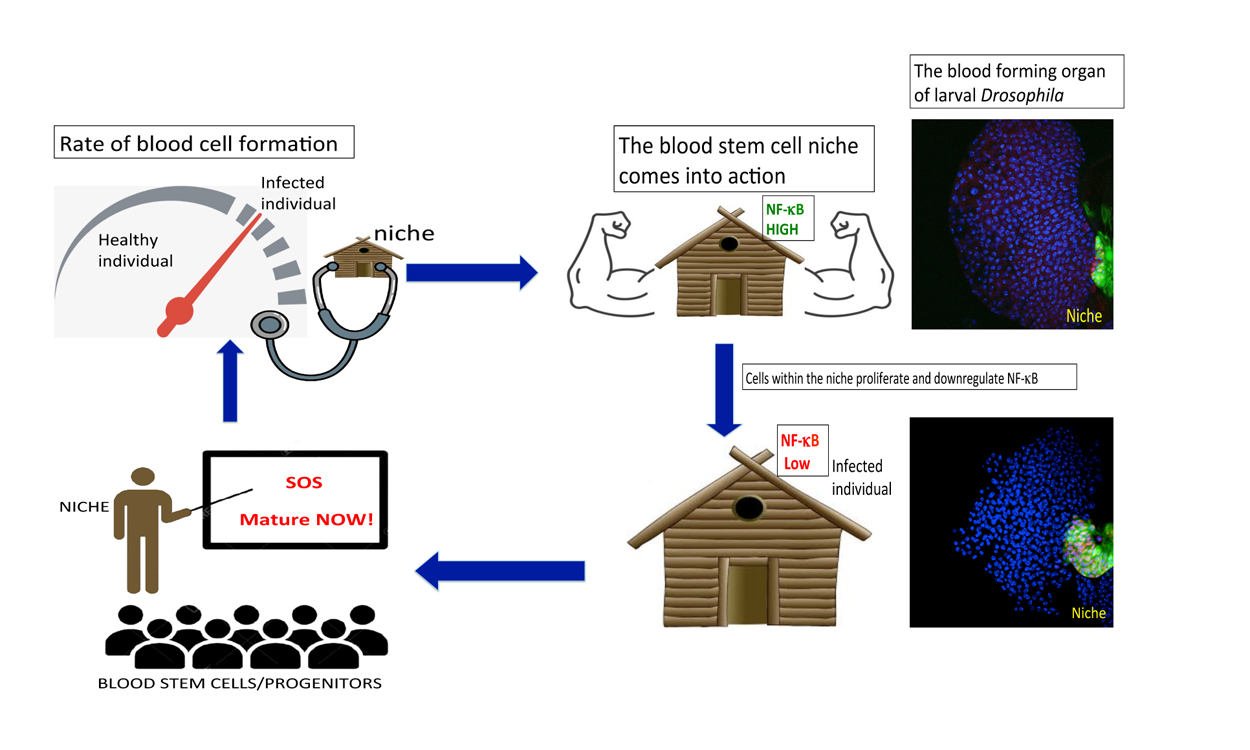 Mandal laboratory believes that the capacity of the stem cell niche to sense the physiological state of an animal and thereafter dictate the stem or progenitor cell fate can be exploited for niche based therapeutic interventions in coming years.
The research group included Parvathy Ramesh, Nidhi Sharma Dey, Aditya Kanwal, Sudip Mandal and Lolitika Mandal from the Indian Institute of Science Education and Research (IISER), Mohali.
Journal Reference:
Relish plays a dynamic role in the niche to modulate Drosophila blood progenitor homeostasis in development and infection
Disclaimer:
SciSoup claims no competing interest. To ensure accuracy and scientific relevance, this science blog has been run past the researchers - whose work is covered.